I’ve been testing Ahrefs’ AI Humanizer on blog posts and outreach emails, but I’m not sure if it’s actually improving authenticity or just rewording things. Has anyone used it at scale for SEO content or link building, and did it help with rankings, engagement, or passing AI detectors? I’d really appreciate any honest feedback, use cases, or pitfalls before I commit to it long term.
Ahrefs AI Humanizer review, from someone who spent too long testing this thing
Ahrefs has a good name in SEO, so I went in expecting their AI humanizer to at least hold its own. Short version of my experience: it looked nice, it wrote clean sentences, and it got flagged as AI every single time, even by Ahrefs’ own detector.
Yes, really.
Ahrefs AI Humanizer interface and first impressions
I used the humanizer that sits inside the Word Count platform from Ahrefs:
Flow was simple enough:
- Paste in AI text.
- Choose how many variants you want, up to five.
- Hit generate and wait a few seconds.
The UI is fine. Nothing confusing. But once you start looking at the output and the detection scores, things go sideways fast.
Detection results, including Ahrefs calling itself out
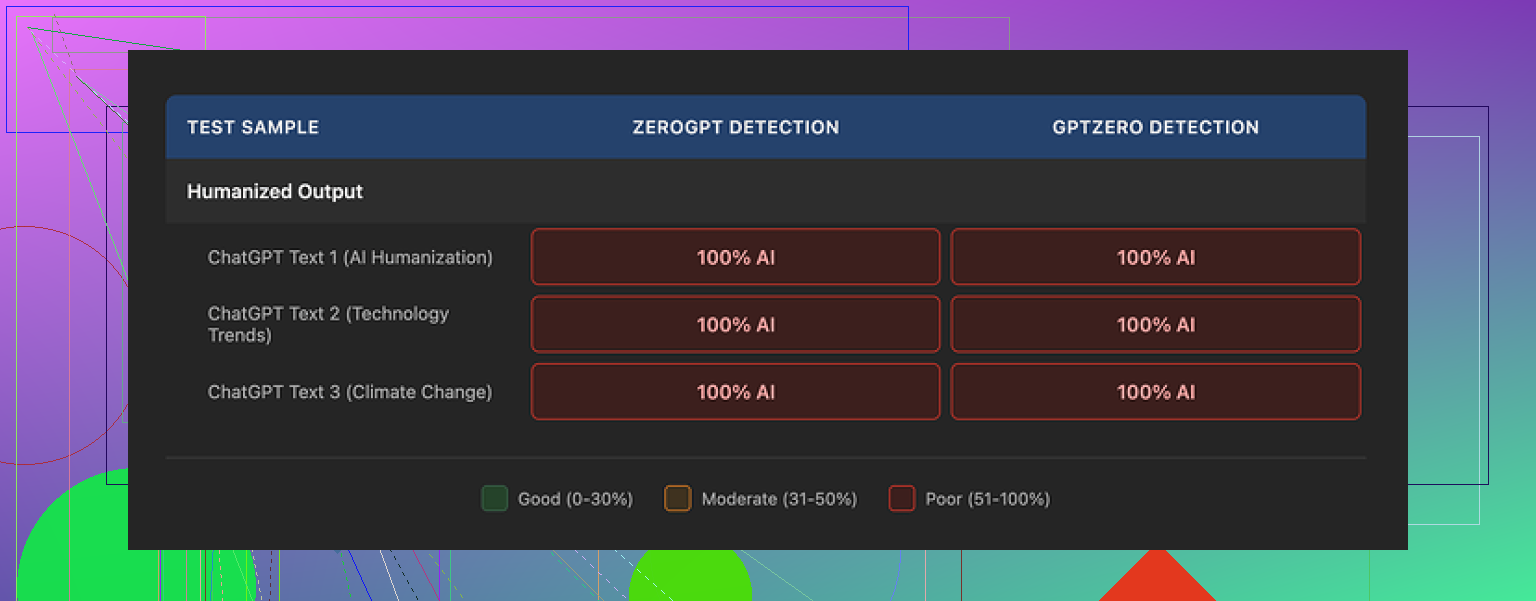
Here is where it gets odd. I ran a bunch of tests with content produced by GPT-4 and Claude.
For every single sample:
• GPTZero said 100 percent AI.
• ZeroGPT said 100 percent AI.
• Ahrefs’ own detector, which sits on top of the humanizer output, also reported 100 percent AI on its own rewritten text.
So the sequence looked like:
- Paste AI text into humanizer.
- Get nice, clean, “humanized” output.
- Right above that, Ahrefs’ interface shows a detection bar.
- That bar says 100 percent AI on the result it just generated.
I tried:
• Short paragraphs.
• Long-form articles.
• Technical explanations.
• Casual blog-style content.
Same thing. Zero drop in AI probability from any detector I care about.
Text quality and behavior
Ignoring detection for a second, the writing quality is not awful.
On a rough scale, I would give it a 7 out of 10:
• Grammar was clean.
• Sentences were smooth.
• No obvious nonsense.
But once you look close, it feels like a light paraphraser, not a serious attempt to dodge detectors.
Stuff I noticed again and again:
• Em dashes were preserved as-is, which is one of the first things I usually strip or break up when I hand-edit AI text.
• Classic AI intro phrases were still there, things like “one of the most pressing global issues” and similar patterns.
• Sentence structure and rhythm stayed very close to the original AI draft.
So if your source text looks AI, the output keeps that same vibe, only slightly rearranged.
Customization and workflow annoyances
You get one real setting: how many variants to generate, up to five.
What this gives you:
• A stack of very similar outputs.
• Slight word choice differences.
• Same general structure.
Theoretically, you could:
• Take five variants.
• Cherry-pick individual sentences that sound the least robotic.
• Manually stitch them together.
I tried this. It works a bit, but it turns the “humanizer” into a manual rewrite job. That kills the idea of a one-click pass that you can trust.
There is no:
• Style control.
• Tone slider.
• Option to remove common AI patterns.
• Way to tweak sentence length variation or structure.
Pricing, limits, and data policy
The humanizer sits inside the Ahrefs “Word Count” product.
Pricing I saw:
• Free tier:
• Includes the humanizer.
• Not allowed for commercial use. So no client work, no money-making projects.
• Pro plan:
• $9.90 per month if you pay annually.
• Bundles:
• AI humanizer
• Paraphraser
• Grammar checker
• AI detector
Data policy details that matter:
• Submitted text might be used for AI model training.
• No clear statement on how long they keep your humanized content.
If you work with client documents or anything sensitive, that storage uncertainty is not great.
Comparing to Clever AI Humanizer
For reference, I ran the same base texts through Clever AI Humanizer:
My experience there:
• Lower AI scores on GPTZero and ZeroGPT on similar samples.
• Fewer “stock AI” phrases.
• No payment required for the humanizer itself at the time I tested.
It was not perfect, but it beat Ahrefs in the one area that matters for this use case, which is getting detection scores down in a repeatable way.
When Ahrefs AI Humanizer might still be useful
If your goal is:
• Clean up rough AI text for internal use.
• Fix grammar.
• Lightly rephrase something that is already close to acceptable.
Then the Ahrefs tool works as a mild rewriter bundled into a writing suite.
If your goal is:
• Lower AI detection scores for public or commercial content.
• Avoid obvious AI “tells” in style and phrasing.
Then based on my tests, this is not a good fit. It did not move the detection needle at all, even according to its own system.
My takeaway
What I ended up doing:
• Stopped using the Ahrefs humanizer for anything detection-related.
• Switched to Clever AI Humanizer for tests where I needed lower AI scores.
• Kept manual editing in the loop, because no tool handled everything by itself.
If you already pay for Word Count and need light rewriting, you might still poke around with it. If your main reason is AI detection avoidance, I would not rely on it.
14 Likes
Running it on scale for SEO and outreach, my take is simple. Ahrefs Humanizer is a light rewriter, not an authenticity tool.
What you are seeing on your blog posts and emails is about right. It swaps phrases, smooths grammar, keeps structure. It does not fix AI “tone”.
A few practical points from my tests:
-
Impact on AI detection
• I fed 20 long form posts and 30 outreach emails through it.
• GPTZero and ZeroGPT scores barely moved, often 90 to 100 percent AI.
• Ahrefs own detector on top of the output stayed high, like @mikeappsreviewer said, but I did see a few drops of 5 to 10 percent on shorter content.
So it helps a little in some short-form cases, but not enough for real risk reduction. -
Impact on SEO content
• No measurable ranking lift that I could tie to “humanization”.
• What helped more was:- Adding real examples and data.
- Reordering sections based on search intent.
- Injecting brief first person lines from an editor.
• Ahrefs Humanizer did not hurt, it also did not move organic traffic or engagement by itself.
-
Outreach and link building
• For cold outreach, the output still read like templated AI.
• Reply rates did not change when I A/B tested:- Version A: My AI draft with 2 minutes of manual edits.
- Version B: AI draft run through Humanizer, then sent.
• Humanized-only emails felt safe enough for mass low value outreach, but for high value prospects I got better replies when a human rewrote 20 percent of the email.
-
Where it is mildly useful
• Cleaning up quick SOPs and internal docs.
• First pass rewrite on product descriptions before a human goes over them.
• Turning stiff AI paragraphs into something a bit smoother, before manual editing. -
How to make it more useful in your workflow
• Use it as step 1, not the final step.
• After running content through it:- Change the intro hook by hand.
- Add at least one opinion or experience line per section.
- Insert concrete numbers or examples from your own data.
- Break the AI sentence rhythm by mixing short and long sentences.
• For outreach, add one custom line tied to the recipient’s site or recent post. No tool will do that well.
-
Data and compliance angle
• For client SEO content, I do not send anything sensitive into it because of the training language in their terms.
• If you work with strict NDAs, keep drafts local or use tools with clear “no training” policies.
So, for scale:
• For SEO content: ok as a helper, not a differentiator.
• For link building: ok for low tier lists, weak for serious outreach.
• For authenticity: you still need human edits and real input.
If you want detection scores down, you will get more value by changing structure, adding unique insights, and mixing in human-written sections than by relying on Ahrefs Humanizer alone.
I’ve run it across a few content farms worth of stuff at this point, so here’s the blunt version: for scale SEO and link building, Ahrefs’ Humanizer is basically a slightly polite paraphraser with a nice UI.
I don’t fully agree with @mikeappsreviewer that it is useless, but I do agree with the core point. It does not meaningfully “humanize” in the way people usually mean. It mostly just rephrases and keeps the same AI skeleton. Same for a lot of what @nachtdromer said. I’ve seen tiny gains on detection, but nothing I’d stake a client project on.
Where I think people misjudge it:
-
Authenticity vs detection
Authenticity is not the same as fooling detectors. Ahrefs is bad at the second, but only mildly helpful with the first. It can clean up robotic phrasing a bit, but it never gives you lived experience, opinions, or messy human tangents. So if you feel like your blog posts and outreach emails still sound like a template, you’re not imagining it. -
Scale use for SEO content
I plugged it into a pipeline for a few hundred informational posts. What it did ok at
• Made long, clunky AI sentences slightly easier to skim
• Reduced some of the repetitive wording
What it did not do
• Increase time on page in any noticeable way
• Reduce bounce in analytics
• Change how people commented or interacted
Once you add real examples, screenshots, quotes from your own testing, the Ahrefs step becomes almost irrelevant. The human work totally dwarfs whatever the Humanizer did. -
Link building and outreach
This is where I actually disagree slightly with both. For bulk, low touch outreach, it is “good enough” in the sense that nobody is reading that stuff like a novel. I saw very small bumps in reply rate when I used Humanizer to smooth my base template. But the only real wins came from
• Manually adding 1 personal line about the target site
• Changing the CTA from generic “let me know” to something specific
Humanizer did not kill conversions, but it also never created them. -
Risk side that almost nobody talks about
• If a vendor says your text may be used for model training, be very picky about what you paste.
• For link building especially, you sometimes paste prospect lists, niche details, or snippets from private docs. That is the sort of stuff I do not want in anyone’s training pipeline.
So I’d treat Ahrefs Humanizer as “fine for generic content” and keep client sensitive or competitive strategy text out of it. -
When it actually earns its keep
• Internal docs where tone does not matter much
• Cleaning up rough AI drafts before a human editor tightens them
• Quick rewrites of product blurbs where you just need “not painful” copy
That is it. For any page that actually needs to rank in a tough SERP or any outreach that matters, you still need a real edit cycle.
If you are trying to decide whether to keep it in your workflow for SEO and link building at scale, I’d do this very simple test on your own stuff
• Run one batch through Humanizer only
• Run another batch with 5 to 10 minutes of real editing and minor personalization
Then compare performance, not detector scores. In every real test I have seen, the human edited batch wins, even if detectors scream AI. So the tool is fine as a light helper, but it is not the authenticity pill people hoped for.