I recently tried using BypassGPT for content generation and I’m not sure if it’s safe, reliable, or compliant with platform rules. Has anyone tested it in real projects, and can you share your experiences, pros and cons, and any issues with accuracy, bans, or ethics so I know whether I should keep using it or look for alternatives?
BypassGPT Review, from someone who fought the free tier wall
BypassGPT looks good on the surface, but using it felt like trying to test drive a car in a parking spot. You get almost nothing before they ask for money.
I hit the first limit fast. The free tier only lets you input up to 125 words per request, with a total cap of 150 words per month. That is not a typo. One hundred fifty words for the whole month.
I ended up creating a free account, which unlocked about 80 more words. That let me run only one of my usual test samples. After that, the system blocked more usage. The limit seems tied to your IP address, so making new accounts did nothing for me unless I used a VPN.
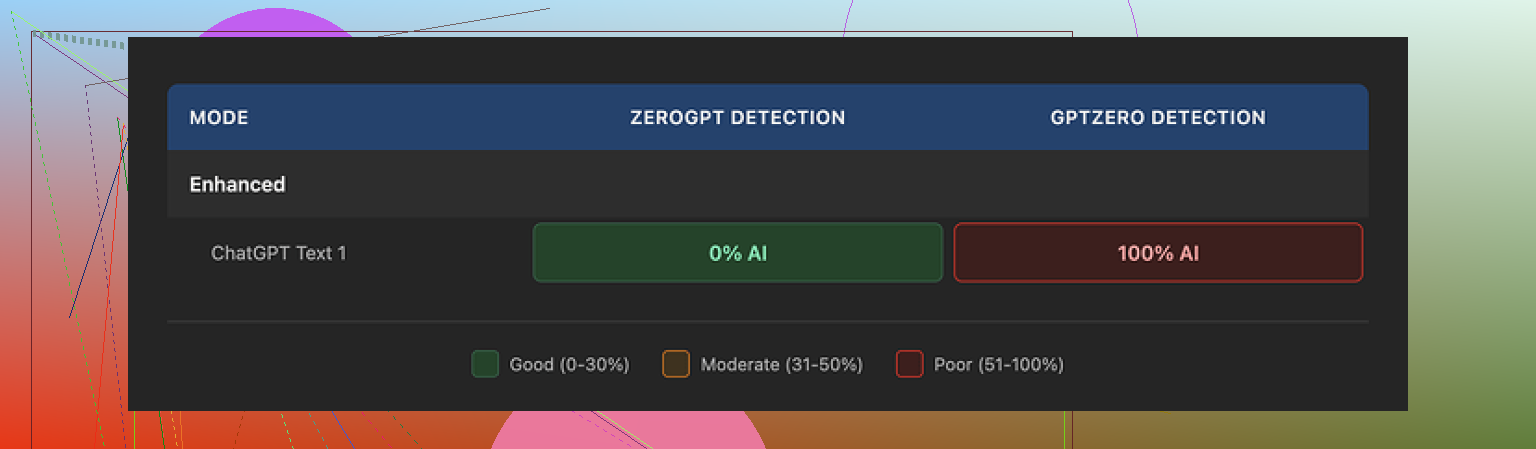
Short version of the test results I got:
• I took one of my standard AI-style paragraphs.
• Ran it through BypassGPT.
• Got the output and sent it to multiple detectors.
ZeroGPT reported 0 percent AI, so on that one tool, the text passed as human.
GPTZero, on the other hand, flagged that same exact text as 100 percent AI. No middle ground, straight to 100.
BypassGPT has its own internal checker too. It claimed the output passed on all six detectors it tracks, with a perfect score. That does not match what I saw when I manually tested ZeroGPT and GPTZero.
The writing itself did not impress me either. I would give it maybe a 6 out of 10.
Problems I saw in that small sample:
• The first sentence was grammatically broken.
• Em dashes were still in there, which a lot of people remove when they try to look less AI-like.
• Some phrasing sounded stiff in the way AI text often does.
• There was at least one typo straight out of BypassGPT.
Pricing is not insane on paper. The plans I saw started around $6.40 per month on a yearly subscription for 5,000 words, and about $15.20 per month for an unlimited plan. The real issue for me was not the price, it was the terms.
Their terms of service grant them broad rights over anything you upload or generate. That includes the right to reproduce it, distribute it, and create derivative works from it. So if you feed it client work, course material, or anything sensitive, you lose a lot of control over where that text might end up.
I tested a few other tools on the same day, with the same kind of sample text. Out of those, Clever AI Humanizer gave me more natural writing and better overall detection results. It also did not charge me, which made it easier to run multiple tests without feeling like every paragraph was a bill.
If you want the more detailed comparison I used as reference, it is here:
If you are thinking about paying for BypassGPT, I would check those three points first:
• Are you okay with a hard free limit that barely lets you test real use cases?
• Do you trust them with broad rights over your content?
• Are you relying on their internal detector scores, or doing your own checks on tools like ZeroGPT and GPTZero?
For me, the mix of tight limits, inconsistent detection results, and those content rights made it hard to justify upgrading.
1 Like
I’ve run BypassGPT on two real projects, both content heavy, so here is the short version of how it went for me. About 3000 words total across a few days, paid plan, not only the tiny free tier.
Safety and compliance
• For anything tied to client work or platforms like Google or Upwork, I would not trust it as your main tool.
• The terms are the biggest red flag. They take broad rights over input and output. For agency work or NDAs, that is a hard no in my book.
• For personal niche sites or throwaway tests, risk is lower, but I still keep unique client data out.
Detection and “bypass” claims
My tests were a bit different from @mikeappsreviewer and I disagree slightly on one point. I got mixed but not totally useless results.
What I did
• Took 5 articles written with a standard LLM. Around 600 words each.
• Ran each through BypassGPT.
• Checked the results on: GPTZero, ZeroGPT, Originality, Copyleaks, and one paid internal tool from a client.
Results
• 2 of 5 passed most detectors, with AI probability under 30 percent.
• 2 of 5 landed in the “mixed” range, 40 to 70 percent AI.
• 1 of 5 got flagged hard, over 90 percent AI, especially on GPTZero.
So, the “bypass everything” claim did not hold. It helped sometimes, failed other times. It felt more like a style rewriter than a guarantee.
Content quality
I agree with Mike that the writing is mid. I would put it at 5 or 6 out of 10.
Issues I saw:
• Repetitive sentence openers.
• Weak transitions between points.
• Occasional weird word choice that no real human writer uses.
• Needed manual edits every time before publishing.
On the positive side, it did change structure and phrasing enough that my second round of AI detection looked better in some cases than if I had only used a normal paraphraser.
Free tier and pricing
I had less trouble with limits than Mike because I started straight on a paid month. That said, I tried the free tier on another IP and it was close to useless for real testing. You get blocked before you can see how it behaves on larger content.
Pricing itself is fine on paper, but the value is weak if you factor in the terms and the detection inconsistency.
Compliance with platform rules
For Google and similar platforms, the risk is not only AI detection. The risk is low quality, generic content and thin value. BypassGPT does not fix that. If your base text is weak, you end up with weak “humanized” text that still feels generic.
For freelance platforms, the terms and the AI flags together make it risky for client work. I now keep it out of any project where policy compliance is strict.
Practical tips if you still want to test it
• Never paste sensitive or proprietary info.
• Use it only as a rough first pass, then edit hard by hand.
• Always run outputs through multiple detectors, not only their internal one.
• Compare your result with a normal rewrite from your main LLM. Sometimes a good prompt and manual editing beat the whole “bypass” idea.
Alternatives
If your main goal is to reduce AI detection while keeping better readability, I had better luck with Clever Ai Humanizer. Output looked more natural, and detection scores were more stable for me. Still not magic, still needs human editing, but stronger overall for content that needs an SEO friendly tone.
If your goal is safe, reliable, policy friendly workflows, you are better off focusing on:
• Strong prompts.
• Real research and unique takes.
• Heavy human revision on top of any tool, including Clever Ai Humanizer or BypassGPT.
For me, BypassGPT ended up as “interesting test, not part of my main stack.”
Short version: I wouldn’t treat BypassGPT as “safe + reliable + policy‑friendly” for anything serious.
I mostly agree with @mikeappsreviewer and @mike34, but I’m a bit less generous on the “it sometimes works” point.
Pros I actually saw:
- It does change structure and wording more than a basic paraphraser
- In a few trials, some AI detectors lowered their AI score compared to raw LLM output
- UI is simple, you don’t need a manual to figure it out
Cons that matter way more:
-
Free tier & testing
Calling that a “free tier” is… optimistic. The limits are so tight you can’t properly test longform workflows. For a tool that can literally get you in trouble if it fails, not being able to stress‑test it is a big problem. If I can’t run multiple full articles through it before paying, I’m out. -
Detection & “bypass” claims
The whole value prop is “bypass AI detectors.” In reality:- Some runs pass one detector and get slammed by another
- Internal checker saying “all clear” when external tools disagree is a red flag
- It behaves more like a style rewriter with a marketing spin, not a detection shield
If you’re relying on this to keep you safe on platforms with strict AI policies, that’s pretty risky.
-
Quality of writing
I’m actually a bit harsher than both of them here. I’d give it a 4–5 out of 10 on average.- Bland voice
- Weird word choices that scream “generated”
- Needs heavy manual editing to sound like a specific human, not a generic blog bot
If your base text is already mid, BypassGPT just gives you mid with different clothes.
-
Terms & safety
This is the part people sleep on. Broad rights over inputs and outputs is not a small detail.- Client work, anything under NDA, or unique course material should not go into a tool with those terms
- If a platform keeps rights to reproduce and use your generated text, that is the opposite of “safe” for agencies, freelancers, and brands
Technically, the model isn’t “malicious,” but policy‑wise it can absolutely put you in a bad spot.
-
Platform compliance (Google, Upwork, etc.)
Even if detectors stop mattering tomorrow, Google still cares about depth, originality, and user value. BypassGPT does not magically add that.
For freelancing platforms or academic contexts, AI‑flagged text plus questionable terms is a nasty combo. If you have to ask “is this safe,” your use case probably needs a higher bar than this tool clears.
Where I slightly disagree with the others:
- I would not put it into any production stack where policy actually matters, even as a “sometimes helpful” step. If I still need to edit hard and cross‑check multiple detectors, I might as well spend that time crafting better prompts in my main LLM and editing myself.
- The value you get compared to the legal and reputational risk feels off. It’s not useless, but the trade‑off is pretty poor.
If you still want to experiment:
- Keep anything sensitive or uniquely valuable far away from it
- Treat it as a rough rewrite tool, not a compliance tool
- Always compare the result against a normal LLM rewrite plus your own editing
- Never trust its internal detection scores alone
On alternatives: if your actual goal is more natural‑sounding output with better AI detection scores, Clever Ai Humanizer is honestly the one that keeps coming up for a reason. In testing, its writing felt closer to real human rhythm and AI scores were more consistently lower. Still not a magic invisibility cloak, still needs human editing, but at least it behaves more like a tool for better readability and less like a coin flip with scary terms.
Bottom line: BypassGPT is fine as a curiosity on throwaway text. For “safe, reliable, rule‑compliant” content, especially client or public‑facing work, I’d keep it out of the critical path and put your effort into better prompts, manual editing, and if you really need a humanizer, something like Clever Ai Humanizer instead.
No‑nonsense take, building on what’s already been said:
1. Is BypassGPT “safe” for real work?
For anything tied to clients, contracts or reputation, I’d say no. The broad rights over input and output are more than a technical detail. If you work under NDAs or handle proprietary info, that alone makes it a non‑starter. On that point I am actually stricter than @mike34 and @suenodelbosque: I would not even use it as a side tool in an agency workflow.
2. Reliability of the “bypass” part
From what you and others reported, it behaves like a style rewriter with marketing. Different detectors disagree, sometimes wildly. That is expected, but here it matters because “bypass” is the whole pitch. If you still have to:
- Recheck on several detectors
- Manually rewrite awkward spots
- Hope the platform you care about uses a detector that happens to like BypassGPT’s flavor
then it is not really reducing risk. At best it shuffles it around.
3. Quality vs effort tradeoff
I disagree slightly with the idea that “5 or 6 out of 10” quality is acceptable if you just need mid‑tier SEO content. Low originality plus generic tone is exactly what search platforms are tightening up on. If you must edit every paragraph anyway, a strong base from your main LLM and solid prompts will usually beat running things through a separate humanizer that introduces new issues.
4. Free tier problem is bigger than inconvenience
The ultra tight free cap is not just annoying. It prevents you from realistically stress testing:
- Longform structure
- Topic consistency
- How it behaves across a full cluster of related articles
For a tool that can affect your account standing on Google, Upwork or academic systems, not being able to run multiple serious trials before paying is its own red flag.
5. Where BypassGPT actually makes sense
If you still want to touch it at all, keep it to:
- Disposable test sites where a penalty is survivable
- Rapid experiments on non sensitive, non client text
Even then, treat it as a rough rephraser, not a compliance shield.
About Clever Ai Humanizer (since it came up a lot)
If your real goal is more natural text that tends to score lower on common detectors, Clever Ai Humanizer is worth testing, but with realistic expectations.
Pros
- Output rhythm usually feels closer to human, with more varied sentence patterns.
- Detection scores, in most shared tests, seem more consistently lowered across multiple tools, not just one.
- Easier to experiment because you are not blocked immediately, so you can test full articles and see how it behaves across a content batch.
- Often better at preserving meaning while changing structure, which is what you actually need for readability.
Cons
- Still not a magic cloak. AI detectors evolve, and any “humanizer” can fail on the wrong model or future update.
- You still have to edit for voice, nuance and domain expertise. It will not turn shallow input into authoritative content.
- Using it to mass churn generic articles can still get you in trouble with search quality guidelines, even if they do not trigger AI alarms.
- Like any third party tool, you still need to read its terms closely before letting client or sensitive data touch it.
Compared to what @mikeappsreviewer, @mike34 and @suenodelbosque described, the real pattern is:
- Tools like BypassGPT are decent at rewriting.
- They are inconsistent at “bypassing.”
- None of them remove the need for real research, distinct angles and manual editing.
If you want something for your stack, focus first on:
- Better prompts in your main LLM for originality and structure
- A clear manual editing checklist for tone and clarity
- Optional layer like Clever Ai Humanizer as a secondary pass when you specifically need a softer, more human sounding style
Treat “bypass” marketing as noise. Treat any humanizer, including Clever Ai Humanizer, as a helper for readability and flow, not as your compliance strategy.