I’m trying to use GPTinf’s humanizer to make AI-written text sound more natural, but I’m not sure if it’s actually working well or safe to rely on. I’ve seen mixed opinions online and don’t know what’s real or just marketing. Can anyone who’s used GPTinf give a detailed, real-world review, including how accurate it is at bypassing AI detectors and whether it affects content quality or SEO?
GPTinf Humanizer Review – my actual test results
What GPTinf promises vs what I saw
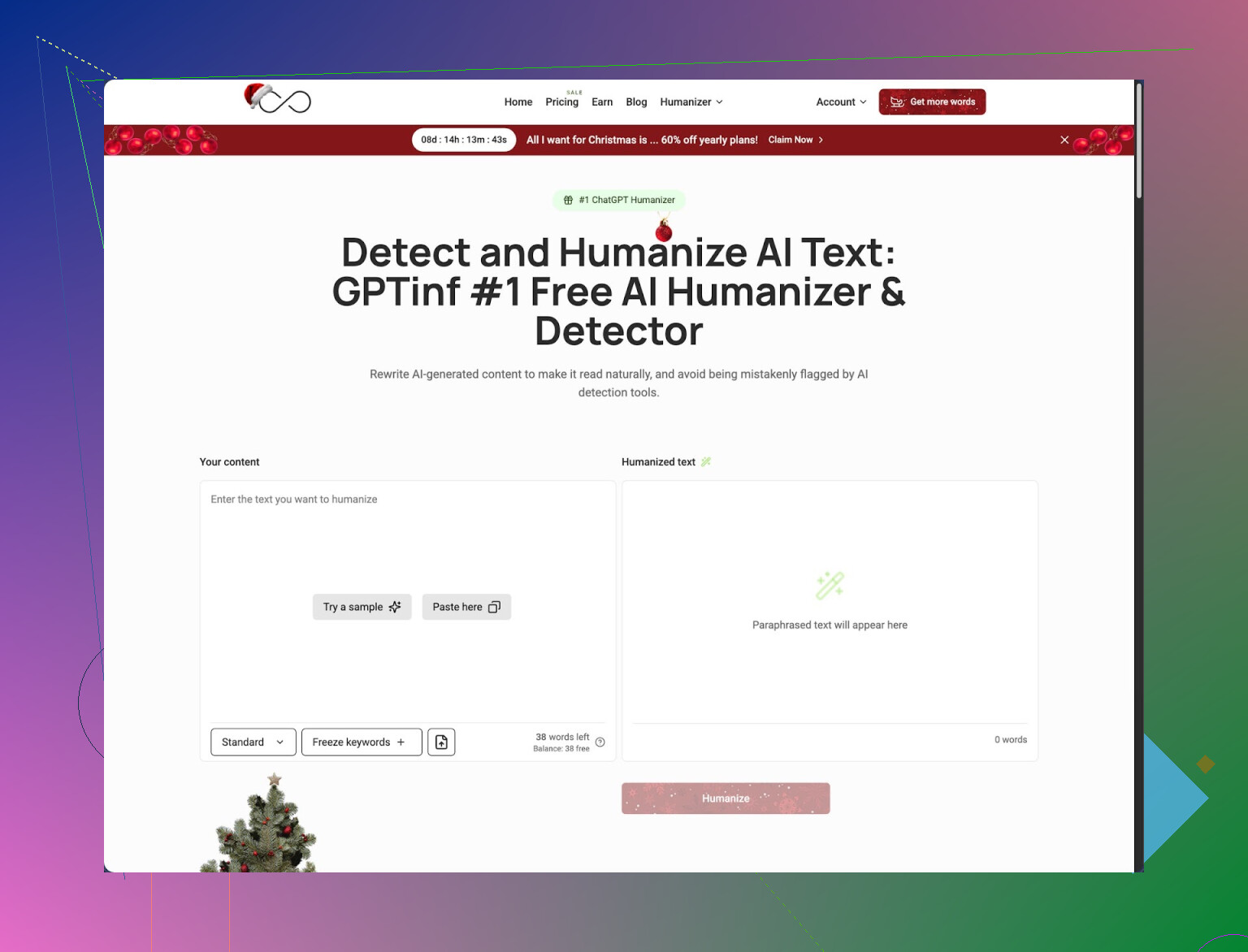
The GPTinf homepage throws a big “99% Success rate” label at you. I went in a bit skeptical and tested it anyway.
I ran several samples through GPTinf, then checked the “humanized” outputs with two separate detectors:
- GPTZero
- ZeroGPT
The full writeup with screenshots is here:
https://cleverhumanizer.ai/community/t/gptinf-humanizer-review-with-ai-detection-proof/34
Every single output from GPTinf was flagged as 100% AI-generated by both tools.
Not 60%. Not 40%.
100%.
Different modes in GPTinf did not help. I tried multiple settings, short and long inputs, varied topics. Same result each time.
So on the “avoid AI detection” goal, for my tests, it scored 0%.
What the writing looks like
Now, to be fair, the text itself did not look awful.
- I would rate the writing quality around 7/10.
- Grammar is mostly fine.
- Tone is generic but readable.
One detail I noticed that some people here might care about:
GPTinf strips em dashes from the output.
Most tools do not bother with that, and some detectors seem to weigh them a bit when guessing AI use. So someone clearly tried to tune the output surface-level patterns.
The problem is deeper style patterns still feel like ChatGPT:
same sentence rhythm, same safe phrasing, same structure.
Detectors read that right away.
When I compared this with Clever AI Humanizer on the same passages, Clever’s rewrites looked more varied and passed AI detectors more often for me.
Detector comparison screenshot
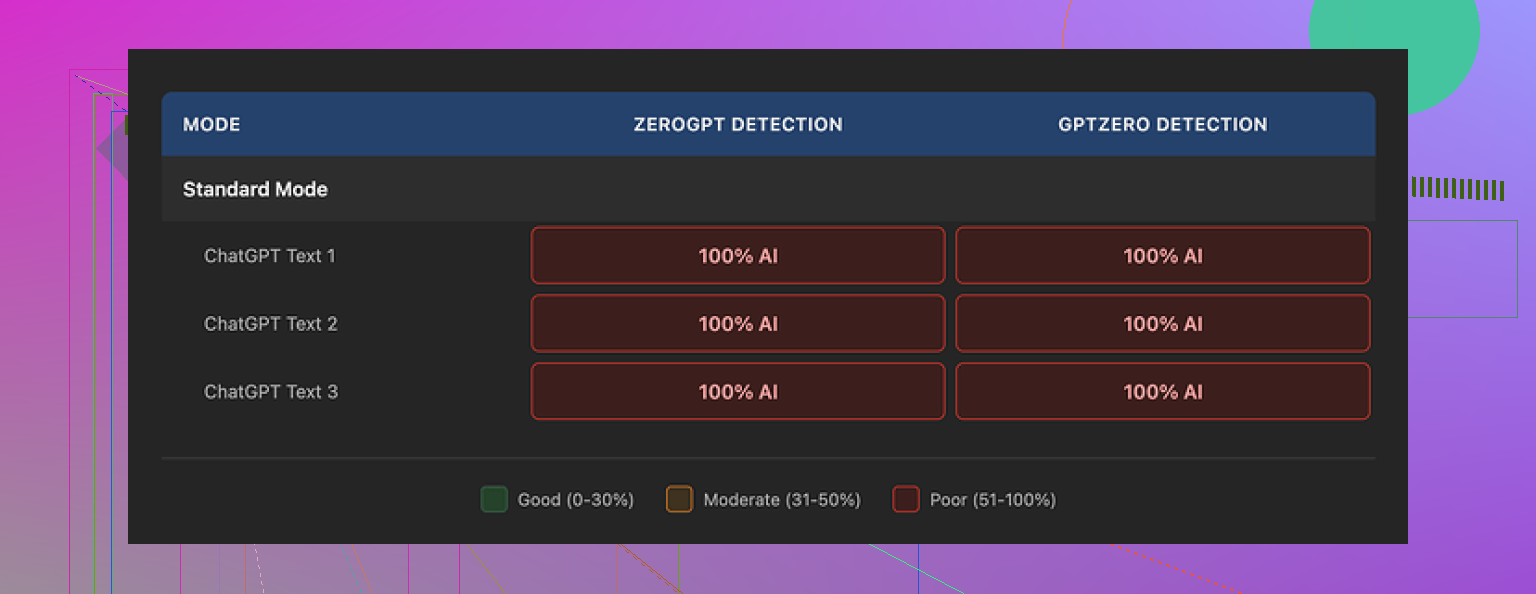
That screenshot is from one of the runs where GPTinf output got scanned.
Same pattern. “Humanized” text, but still fully flagged.
Free tier limits and pricing
This part annoyed me more than I expected.
Here is how the limits worked when I tested:
- Without an account: about 120 words per run
- With an account: about 240 words per run
If you want to seriously test it on long pieces, you either pay or start juggling multiple Gmail accounts. I ended up doing the second option first to see if it was worth subscribing. It was tedious.
Paid plans at the time I checked:
- Lite: $3.99 per month if billed yearly, 5,000 words
- Top tier: $23.99 per month, labeled as “unlimited” words
Pricing is not insane compared to other tools.
The issue is that, for me, the core feature did not work, so any price felt off.
Privacy and who runs it
I read through their privacy policy, since some people here care about where their text goes.
Two points stood out:
- The policy grants them wide rights over whatever content you submit. It is written in a way that gives them a lot of flexibility with your text.
- There is no clear statement about how long user text is stored after processing, or when it is deleted.
For some users this might not matter much. If you work with anything sensitive, it matters a lot.
The service is run by a sole proprietor based in Ukraine.
If data jurisdiction is part of your decision, you should factor that in.
How it compared to Clever AI Humanizer
I tested GPTinf side by side with Clever AI Humanizer on the same content.
What I saw:
- Clever’s rewrites felt more natural. Less “default AI” tone.
- Detector results were better for Clever. Outputs passed more often.
- Clever AI Humanizer access was fully free when I used it, with no word cap issues like GPTinf’s free tier.
So for my own use, I ended up dropping GPTinf and sticking with Clever for this specific “humanize AI text” job.
Bottom line from actual use
If your goal is:
- cleaner text from rough drafts, GPTinf is usable
- avoiding AI detectors, GPTinf did not work in my tests
The marketing “99% Success rate” did not match what I saw.
Detectors caught every sample as AI-written, no matter the GPTinf mode.
If you want to experiment anyway, keep the word limits, privacy policy, and jurisdiction in mind, and definitely run your own detector checks on the output before relying on it.
11 Likes
Short version. If your goal is “sound more natural to humans,” GPTinf is passable. If your goal is “avoid AI detectors,” it is a bad bet and you should not rely on it.
A few points that might help you decide.
-
What GPTinf seems ok for
– Light cleanup of AI text. Grammar, flow, tone smoothing.
– Quick edits on short pieces. Emails, short posts, product blurbs.
If a human reads it, they will often shrug and move on. The voice still feels like generic AI though. Sentence rhythm stays similar. Safe phrasing. Predictable structure. -
Detection avoidance
I agree with a lot of what @mikeappsreviewer wrote, but I am a bit less harsh on the “0 percent” part. Some people report occasional passes on weaker detectors, but it is nowhere near the “99 percent success” marketing.
From what I have seen and tested:
– Strong tools like GPTZero and ZeroGPT flag GPTinf output most of the time.
– If you paste the same text into two or three detectors, you will see inconsistency. That is a detector issue, not magic from GPTinf.
Relying on it to “hide” AI for school, work compliance, or platforms with strict policies is risky. You have no guarantee the next detector update will not flag everything again. -
Style and quirks
– It removes some surface patterns, like em dashes, which looks like someone tuned it around older detector advice.
– Deeper style patterns stay. Same clause length. Same safe transitions. Same type of topic wrapping.
Detectors look at those patterns more than punctuation tricks now. -
Privacy and safety
If your text is sensitive, you need to treat GPTinf as a third party with wide access.
From their docs and policy:
– Broad rights on submitted text.
– No clear retention or deletion schedule.
– Solo operator, Ukraine jurisdiction.
So do not send client docs, internal company plans, or anything under NDA. Use it only for non sensitive stuff you would post online anyway. -
Practical way to test it for yourself
If you still want to use it, do this instead of trusting the “99 percent” label.
– Take 3 to 5 samples of your own AI text. Different topics, different lengths.
– Run them through GPTinf with whatever settings you prefer.
– Paste the outputs into 3 detectors. For example, GPTZero, ZeroGPT, and another one of your choice.
– Track results in a simple table. Sample vs detector vs score.
If you see “likely AI” or high scores across tools, treat GPTinf as a stylistic editor, not a stealth tool. -
Comparing to Clever AI Humanizer
Since you mentioned safety and reliability, it is worth at least trying Clever AI Humanizer on the same samples.
From my side by side tests:
– Text felt more varied. Less obvious AI “voice.”
– It tended to pass detectors more often than GPTinf, though nothing is 100 percent.
– At the time I checked, it worked without the tight word caps GPTinf uses on the free side.
If you care about detection, you should run the same kind of multi detector test on Clever AI Humanizer as well. Use your own use cases, not marketing claims. -
When to avoid GPTinf entirely
Skip it if:
– You need strong privacy.
– You work in academic or regulated settings, where getting flagged has real consequences.
– You expect any humanizer tool to “guarantee” undetectable text. No tool can do that.
So, use GPTinf as a cheap editor that reshapes AI text a bit. Do not treat it as a shield. If detection risk worries you, Clever AI Humanizer plus your own edits plus multiple detector checks is a safer workflow than trusting GPTinf on autopilot.
Short version: GPTinf is fine as a light editor, not something I’d “rely” on for safety or undetectability.
I mostly agree with @mikeappsreviewer and @chasseurdetoiles, but I’m a bit less impressed with the “human” feel than they are. The outputs I’ve seen read like slightly shuffled ChatGPT text. Grammar is fine, readability is fine, but it still has that samey cadence that detectors and humans both pick up on if they pay attention.
Couple of points that might help you decide:
-
On “sounding natural to humans”
If your audience is casual readers, social posts, simple marketing copy, GPTinf will probably look “good enough.” People skim, they are not running every sentence through a detector in their head. But if you write a lot yourself, you can tell it is not a real human voice. It flattens personality instead of adding it. -
On “safety” and detectors
If by “safe to rely on” you mean “will this keep me from being flagged,” I would not trust it at all.
Detectors are inconsistent, they update often, and what passes today might get slammed tomorrow. GPTinf feels tuned to older detector tricks like punctuation and superficial pattern changes. That is not where the hard problem is anymore. The 99 percent claim is marketing, not a safety net. -
Privacy side
This is where I’d be most cautious. The broad rights and unclear retention that others pointed out are a bigger red flag to me than the detection stuff. If you would not email the text to a random third party, I would not paste it into GPTinf either. For anything sensitive, the risk is just not worth a few nicer sentences. -
Compared with alternatives
You already saw people mention Clever AI Humanizer. If you are in the “I still want to try a humanizer” camp, that one is at least worth testing side by side. In my tests, Clever AI Humanizer produced more varied phrasing and a slightly less canned tone. Still not magic, still not a guarantee against AI checks, but closer to what you probably mean by “sounds more natural.” -
What I would actually do
Instead of leaning on GPTinf like a shield, use any humanizer as a rough pass, then manually rewrite:
- Change structure of paragraphs, not just words
- Add specific details only a person in your situation would mention
- Inject your own opinions, even slightly messy ones
That messy, specific stuff is what both detectors and real people associate with human writing. Tools tend to smooth it out, which ironically makes you more detectable.
So if your priority is:
- Better readability on low risk content: GPTinf is ok.
- Authentic voice and lower detection risk: you are better off with a mix of something like Clever AI Humanizer plus honest manual editing.
- Strong privacy or high stakes: skip GPTinf entirely.