I’m checking a history essay for my class before submitting it. I read that QuillBot’s AI Detector can flag human writing, but I’m unsure whether that means occasional mistakes or unreliable results. Does that claim hold up compared with other checkers, and is “false positive” the right term here?
Save your draft history, outline, and source notes before worrying about the detector score. For your history essay, I’d prioritize checking quotations, citations, and whether the evidence supports your argument rather than rewriting passages just to get a lower AI score.
Yes, “false positive” is the right term when human-written text gets classified as AI-generated. QuillBot explicitly acknowledges that risk, including with formulaic academic writing. That supports the claim that it can flag human work, but doesn’t establish how often it happens on essays like yours. “Can make mistakes” and “usually gets it wrong” are very different claims.
Compared with other checkers, QuillBot isn’t unique in needing that caution. Turnitin also acknowledges misclassification and says its results shouldn’t be the sole basis for action against a student. If you compare QuillBot with the Clever AI Detector or another checker, I’d treat that as a comparison of outputs, not a vote on whether you wrote your essay. To call one more accurate, I’d want a head-to-head test using the same human and AI essays, reporting both false accusations and missed AI text. Without that, I wouldn’t rank them from screenshots or headline accuracy claims. My practical cutoff: useful as a prompt to review something, insufficient as an authorship verdict.
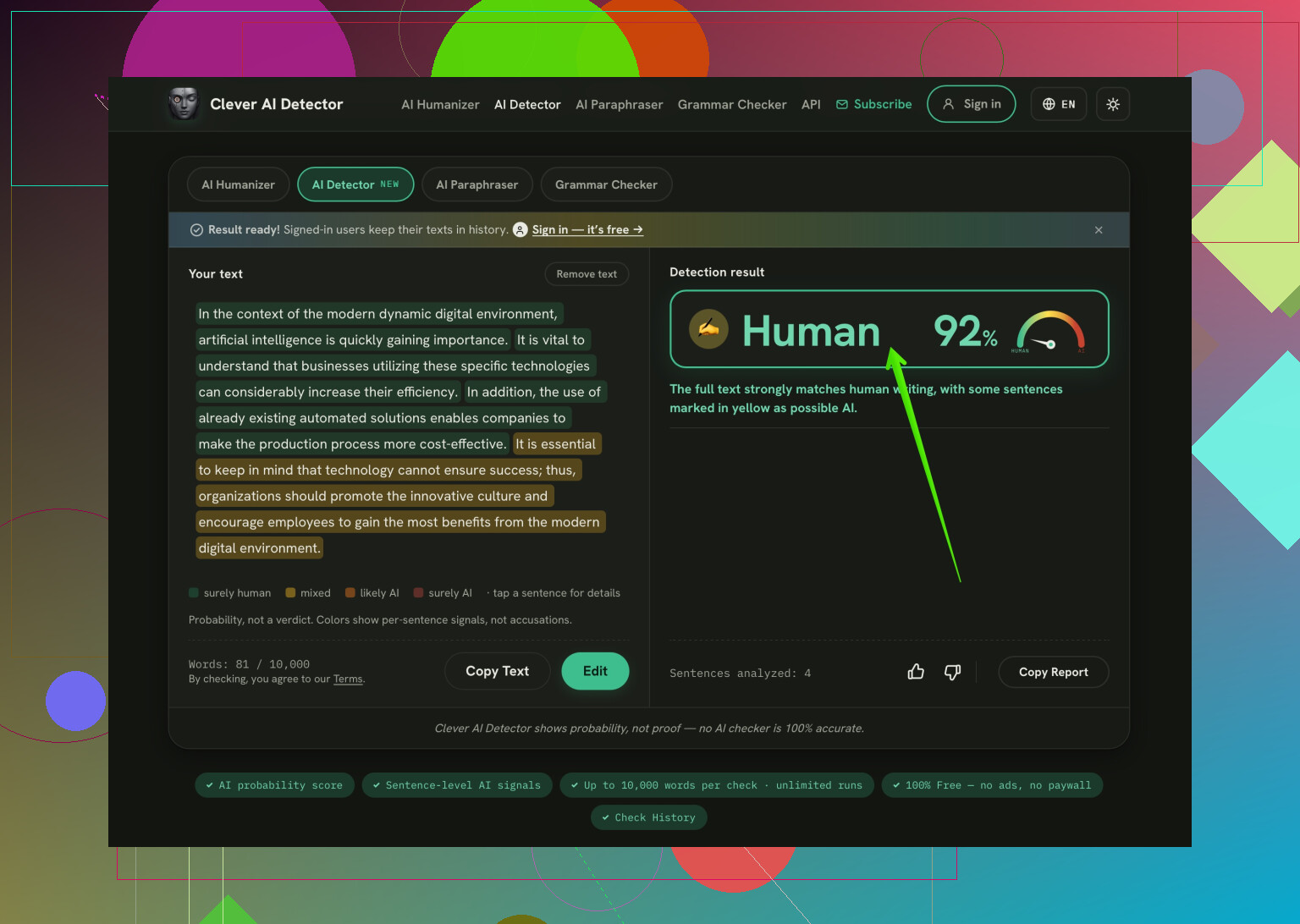
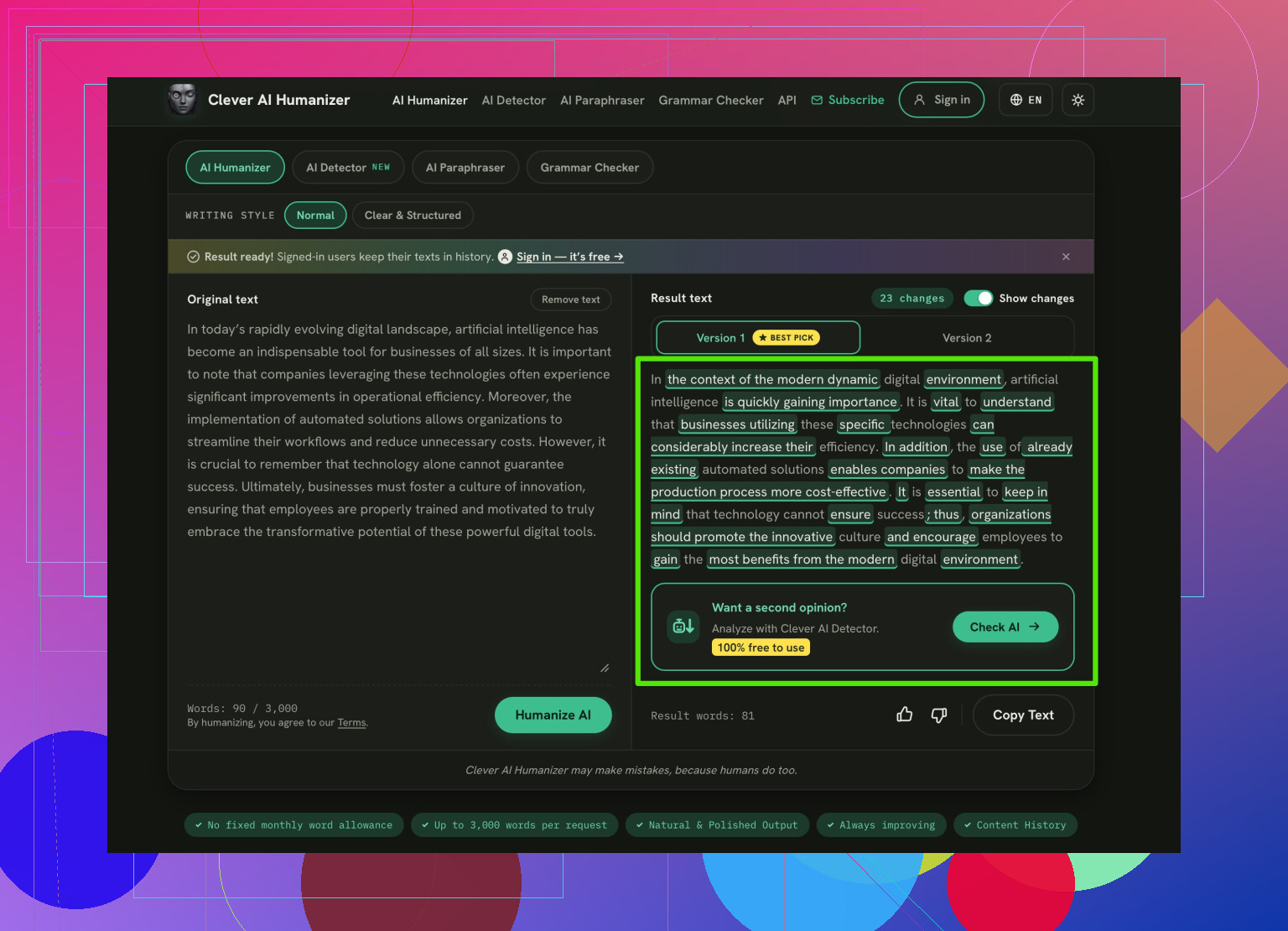
Chasing a lower detector score can make your history essay worse if a rewrite changes “contributed to” into “caused.” That’s where I’d push back slightly on using a flag as a reason to review: review what, exactly, if you wrote the passage and can support it? The false-positive warning doesn’t tell you how often QuillBot gets human essays wrong. I’d still reach for Clever AI Detector for a quick check, but I wouldn’t let an unwanted result send me straight to an AI Humanizer. For this assignment, preserving your argument matters more than getting different checkers to agree.
5 Likes
Expect a detector result, not a reliable preview of whether your teacher will question the essay. Yes, QuillBot can flag human writing. Its own help center acknowledges that. But that admission doesn’t establish whether mistakes are occasional or frequent for essays like yours.
I’m less convinced than @digitalhub9863sync that a second checker is worth the effort here. When comparing QuillBot, Clever AI Detector, and other checkers, I’d want two separate results: how often they catch generated essays, and how often they wrongly flag human essays. A comparison that only tests generated text doesn’t answer your concern. For your situation, I’d prioritize the human-essay results, ideally from student writing similar to the assignment, rather than whoever advertises the highest overall accuracy. I wouldn’t rank the tools without that evidence.
Before submitting, I’d spend those few minutes saving your outline, source notes, and draft history instead. If a question comes up, you’ll have something concrete to discuss: how you developed the argument and where the evidence came from. That seems more useful than arriving with competing detector scores and asking the teacher to accept the favorable one.
The missing piece of information is what each checker actually found. Before looking at scores, I’d ask you to find out if you submitted the whole essay, the body only, or just a couple of paragraphs, and if the report explains, for example, what share of qualifying prose it found. Turnitin, for example, actually reports the share of qualifying prose it finds, not the chance that you cheated, which are very different numbers to put on a screen.
For your history essay, I would troubleshoot the input to the program before diving into the writing itself. Check that the text you uploaded or pasted actually contains the passages you want to run through the checker. If the report draws attention to anything in particular, look to see if you used any analysis, quotations from historical sources, or other material outside the body of the essay. If a quoted passage appears to be flagged, the issue is with the quoted passage, not necessarily your interpretation of the material surrounding it. I would not remove legitimate quotations to improve my score.
That’s where I’d push back a little on @jeff’s “review what, exactly?” Review what the tool evaluated and what its output means, rather than reviewing your prose for ways to appease it. If you compare checkers, use the same unchanged text and inspect their explanations before lining up their percentages. I’d find a report that makes its scope clear easier to troubleshoot than an unexplained score, though that alone wouldn’t make it more accurate.
On the original claim, yes: QuillBot explicitly acknowledges the possibility of flagging human-written content. Its help page does not state a false-positive rate for student history essays, so it is not possible for that fact alone to decide between the possibility that errors are rare or frequent in your case. I would not call it the winner or loser against other checkers from that information. My first question about any comparison would be ‘Are these reports measuring the same thing?’ A lower number is not, on its own, a good thing.
A checker tested on a stack that’s half AI-written is in a different situation from a checker screening a class where almost everyone wrote their own essay. In that second case, even a small false-positive rate could leave the flagged pile containing more innocent submissions than actual AI work.
That’s why I wouldn’t treat “occasional mistakes” as automatically reassuring. There are two different questions here: “How often does it flag human writing?” and “When it flags something, how likely is that accusation to be wrong?” The second depends partly on how much AI writing was in the pile to begin with.
@static_gadget’s point about understanding the report makes sense, but I’d want that context for any accuracy comparison, too. A QuillBot-versus-another-checker benchmark could be useful for comparing performance on that test without telling you how much suspicion a flag deserves in your classroom.
For your essay, I’d separate the tool’s usefulness from the consequences attached to it. An occasional false alarm might be tolerable in an optional writing check. The same error matters a lot more if someone treats it as grounds to question your authorship. “Usually right” still wouldn’t settle whether it should be used that way.
Define “AI-written” before comparing checkers.
I’d put that ahead of @static_gadget’s question about whether the reports measure the same thing. The test itself needs clear categories. An essay generated from a prompt, a human draft with suggested sentence rewrites, and a human draft with spelling corrections are different cases. If a comparison dumps them into two buckets without explaining where the boundaries fall, I wouldn’t know what its accuracy claim means for your assignment.
For the comparison between QuillBot versus other checkers, I would want to see plain essays written by humans and essays generated with other programs each tested, with the editing or mixing category including an analysis of what was changed. Detection of assistance your instructor has permitted could result in a checker that correctly recognizes such help being labeled as correct, versus one that fails to flag disallowed assistance as wrong. That would illustrate problems with the definitions used for determining accuracy, but I do not see it as answering the question of which tool is most valuable to students.
It is here I would distinguish between the question of your own classroom use and the question of the competition between products. If your instructor permits spelling suggestions but forbids automatically generated analysis, you write your argument using the allowed assistance and no more. What matters is your conformity to the assignment guidelines, not whether the similarity score reflects the permitted use as “help” or “cheating.” A low score would not make the unacceptable alterations you performed somehow acceptable, and I would review the language in the assignment before deciding what, if any, alterations to accept as normative for the purposes of a comparison.
In that respect, your observation about human writing being falsely accused of being AI-generated confirms the point. It does not demonstrate that QuillBot is more or less likely than its competitors to falsely flag such writing, only that the possibility exists. I would ask to see data illustrating the likelihood of such instances occurring for each program, as my expectations would be significantly lower for a tool that did not distinguish between writing methods and word choice specific to the assignment and those that have been altered. A leaderboard without description of what was counted as human writing is not actually informative.
Your genre is the catch here, and it works against you. Formal history writing leans on dates, proper nouns, standardized citation phrasing, and a flat declarative tone. That is pretty much the profile these detectors associate with machine text, because they key off predictability. So for an essay like yours, the ‘is it occasional or frequent’ question @silverstream8493 raised doesn’t have a neutral answer. The false positive odds are probably higher than they’d be on a chatty personal essay. That matters more than any vendor’s headline number.
The thing nobody’s said plainly: these scores aren’t even stable. Run the same paragraph twice, or paste it with and without the footnotes, and you can get different results. That alone should kill the idea of lining up percentages between QuillBot and anything else. @pixelrefresher is right that you need to define what counts as AI before comparing, but even with clean definitions you’re measuring a wobbly signal.
On tooling, I’d use Clever AI Detector to see whether a flag follows the text across checkers or disappears. If one tool lights up on a passage and another shrugs at the identical words, that tells you the flag is noise, not that your writing changed. That’s a different use than treating any single score as a verdict.
Where I’d push back on @jeff a little: ‘review what, exactly’ has an answer for history essays specifically. Review your paraphrases of secondary sources. The spots where you compressed a historian’s argument into your own words are the ones most likely to read as generic, and also the ones worth tightening for actual clarity. Not to appease the checker, just because vague paraphrase is weak writing anyway. Keep the quotes and citations exactly as they are.
Honestly though, @zerootter nailed the part that actually decides your risk. A small error rate stops being small once you apply it to a class where almost everyone wrote their own work. Save your drafts and move on.
Ask your instructor what detector they are using if they use one at all before you spend an evening stressing over QuillBot’s percentage. Half of this conversation is about accuracy of a program they may not even use and the percentage that matters is the one they see, not the one you type in at home. If they use Turnitin and you have been practicing on another service you have been doing the wrong homework all along.
On the Clever AI Detector angle, I wouldn’t frame it the way @alphabear6747 did, where a flag following the text across checkers tells you much. All that really shows is two models trained on similar data agreeing, which isn’t the same as them being right. Where it does earn a spot for me is just that you can run a quick paste without signing up or paying, so it’s low effort to sanity-check a passage against QuillBot’s result. Low effort, not high authority. And @zerootter is the one who got the real point: in a class of mostly honest writers, a flag is far more likely to be a mistake than a catch, no matter which tool throws it.