I’ve been trying out StealthWriter AI for content creation and I’m not sure if it’s really worth relying on for long-term use. Some outputs look great, but other times the writing feels off or inconsistent. I’d like feedback from people who’ve used it more extensively—how accurate, reliable, and safe is it for blogging, SEO content, or professional copywriting? Any detailed experiences or comparisons to other AI tools would really help me decide whether to keep paying for it.
StealthWriter AI Review, from someone who paid for it so you do not have to

I spent a weekend messing with StealthWriter AI
Short version. It charges premium prices, throws a lot of knobs and sliders at you, and still trips the main detector that matters for most people.
Price first, because that hit me right away. The plans sit around 20 to 50 dollars per month depending on usage. That is not pocket change for a tool you run on top of an LLM you already paid for.
On paper it looks solid though. You get:
• Two separate rewrite engines: Ghost Mini and Ghost Pro
• An intensity slider from Level 1 to Level 10
• Style presets you swap between
I went through all of it. Different engines, different levels, different presets.
Detection tests
I used two detectors:
• ZeroGPT
• GPTZero
I fed in multiple samples, mostly informational text. No fluff, no story stuff.
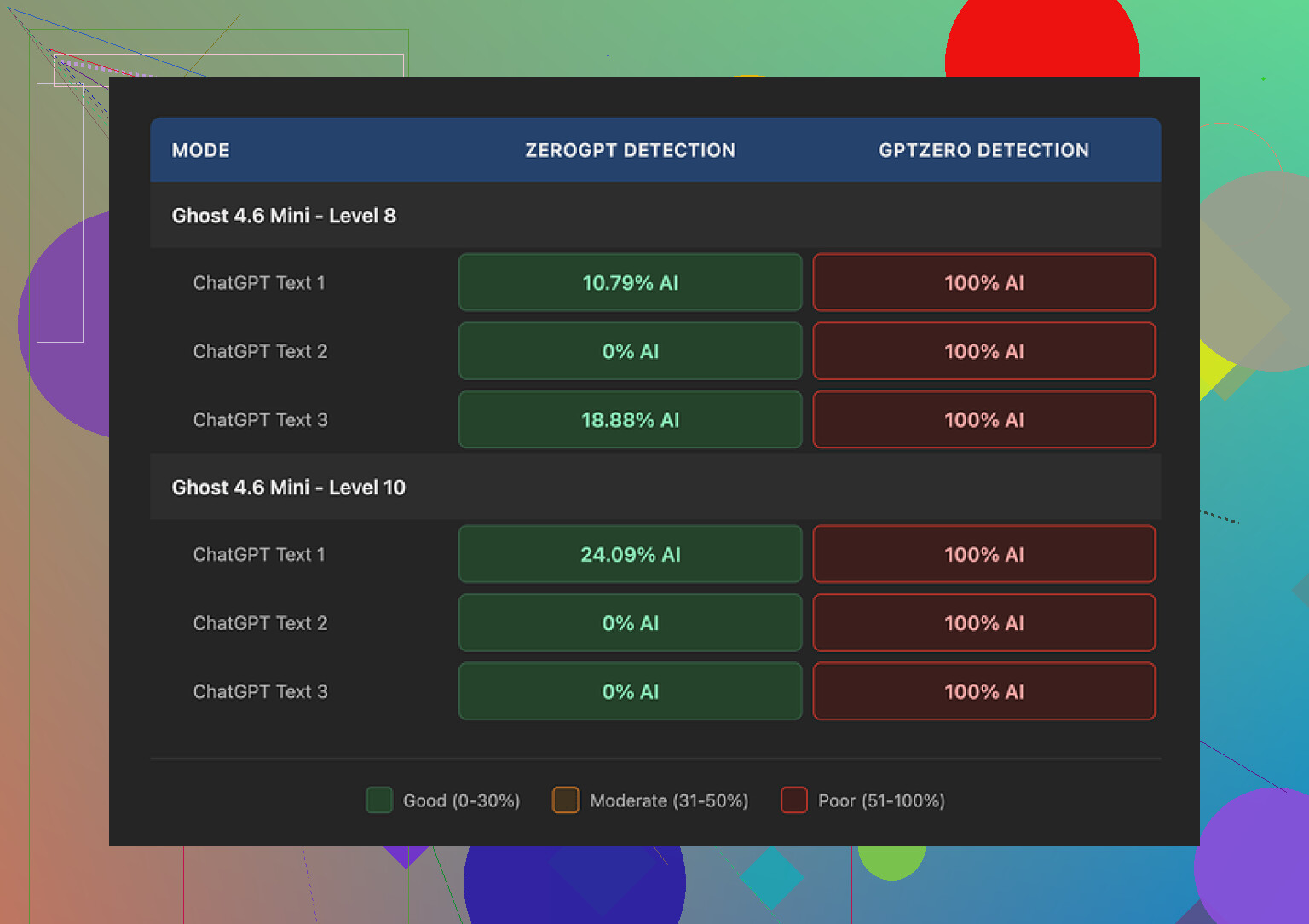
ZeroGPT at Level 8 gave me the best numbers. I saw scores like:
• 0 percent AI on one sample
• 10.79 percent AI on another
So on ZeroGPT alone, Level 8 looked sort of okay.
GPTZero told a different story. Every single output came back as 100 percent AI.
Did not matter if I used:
• Ghost Mini or Ghost Pro
• Level 3, 5, 8, 10
• Different style presets
Same verdict every time. 100 percent AI.
Once that pattern settled in, the extra features started to feel like decoration.
Quality at different intensity levels
The intensity slider changes more than I expected, and not in a good way at the top end.
Level 8
• I would rate the writing around 7 out of 10
• Main ideas stay clear
• You get a few missing words here and there
• Some sentences feel off in a way a decent human writer would not produce
It reads like a rushed ESL student or someone writing at 2 a.m.
Passable for casual stuff, odd for anything serious.
Level 10
Level 10 looked worse and still failed GPTZero.
I kept seeing:
• Strange insertions, like the phrase ‘god knows’ showing up in a climate science piece
• Grammar glitches such as ‘Coastlines areas’
• Phrases like ‘feeling quite more frequent flooding’ that look like a word salad half fixed then abandoned
At that point I felt I was paying to make text more suspicious, not less.
Length handling
One thing it does better than most competitors. It keeps the length close to the original.
A lot of humanizers inflate output by 40 to 50 percent. Paragraphs turn into rambling walls of text. StealthWriter tends to stick to the same scale as the input, which helps if you control word count for assignments, SEO briefs, or client limits.
So if you care about not bloating content, that part is a real plus.
Free vs paid
There is a free tier:
• About 10 humanizations per day
• Up to 1,000 words per run
• You need an account
The catch. Ghost Pro, the fancier engine, sits behind the paid plans. You only get full access once you commit money.
In my own testing, even with paid access, GPTZero still flagged everything, so the paywall did not unlock any magic bullet.
Comparison with another tool
To keep things fair, I ran similar tests with another tool, Clever AI Humanizer.
Quick notes from that session:
• Text felt more natural, closer to a bored but competent human
• Detection scores looked better on the same detectors
• It is free
Not perfect, but more convincing and less expensive, which matters if you rewrite at scale.
Who this might still suit
If your priorities look like this:
• You care a lot about maintaining original length
• You only worry about detectors like ZeroGPT and not GPTZero
• You like playing with intensity levels and presets
Then StealthWriter AI might still be usable for you.
If your main concern is GPTZero or any serious institutional checker, my experience was simple. No setting combination on StealthWriter AI cleared that wall, and the higher intensities made the text worse to read.
13 Likes
I had a pretty similar experience to you, mixed results and hard to trust it long term.
Here is how I would break StealthWriter down from a content creator point of view, without repeating what @mikeappsreviewer already tested.
- Consistency for long term use
For ongoing content, you need:
- predictable tone
- stable quality
- low cleanup time
StealthWriter feels unstable here. Some runs look okay, the next one drifts in tone or drops odd phrases. That kills any workflow where you want a repeatable “brand voice” or fast publishing.
If you need to publish weekly or daily, that inconsistency adds a lot of editing work. You end up line editing every piece, which defeats the point of paying for another AI layer.
- Voice and tone control
The style presets sound useful, but I found:
- Voice shifts mid paragraph
- Formal and casual mix in weird ways
- Occasional “try hard” phrasing that stands out in niche content
If you write in a specific niche (SaaS, finance, health, technical docs), those small tone glitches look amateur.
You can patch it by:
- Locking your own style guide
- Always doing a focused “voice pass” after StealthWriter
- Keeping samples of your own writing nearby and checking against them
But again, that is more manual work.
- Editing time vs subscription price
You pay twice:
- Money per month
- Time per article
Ask yourself:
If StealthWriter disappeared tomorrow, would your process be slower or faster?
When I timed it:
- Direct LLM output + 1 manual edit pass took less time
- LLM output + StealthWriter + manual cleanup took longer, because I had to fix its quirks
So for me, it did not earn the subscription.
- Detection worries
I will slightly disagree with @mikeappsreviewer on one point. I do not think GPTZero is the only “one that matters” in every case.
What matters is:
- Who will read your content
- What tool your school, client or platform uses, if any
If your use is:
- Blog content on your own site
- Affiliate posts
- Social posts
Then you might not care about GPTZero at all, and only care that your text looks human enough to readers. In that case, detector scores are less important than flow, clarity, and conversions.
If your content goes to:
- Universities
- Corporate trainings
- Agencies that explicitly mention GPTZero
Then StealthWriter is high risk, since it keeps failing those tests.
- Where StealthWriter still makes some sense
I would only keep it in these cases:
- You need length almost identical to source
- You accept some odd phrasing and will always edit
- You do not care about strict detection tools
- You like having knobs and sliders to tweak tone
For anything serious, paid client work, or academic risk, it feels shaky.
- A better way to set up your stack
What has worked better for me:
-
Use your main LLM for:
- Outlining
- First draft
- Headline ideas
- Structure
-
Then use a separate “humanizer” only when:
- You need to soften obviously robotic phrasing
- You want to match average human writing patterns
If you want something focused on that, Clever Ai Humanizer has given me more natural output and did not wreck the tone as much. You can try it at
make your AI text sound more human
and compare a few paragraphs side by side with StealthWriter. Run:
- one short blog intro
- one technical explanation
- one casual paragraph
Check:
- which one needs less fixup
- which one preserves your meaning
- which one blends with your existing content
- Practical test for your use case
Since you already use StealthWriter, I would do this simple test before deciding to keep paying:
For one typical article:
- Time how long you spend:
- Drafting
- Running through StealthWriter
- Fixing its output
Then do the same article:
- With your LLM only
- With your LLM plus Clever Ai Humanizer
Compare:
- Total minutes from idea to publish
- How “on brand” the article sounds
- How many lines you rewrote by hand
If StealthWriter is not saving you clear time or stress on at least two out of three, I would drop it.
- SEO friendly description for your topic
StealthWriter AI Review for long term content creation
You are testing StealthWriter AI for regular content work and see mixed results. Some articles look solid, while other outputs feel off, inconsistent, or forced. You want honest feedback on whether StealthWriter AI is worth using for long term content creation, how it performs against AI detectors, and what alternatives give more stable, human sounding results with less editing time.
You’re not imagining it, that “sometimes great, sometimes kinda weird” feeling with StealthWriter is real.
From what you and also @mikeappsreviewer and @cacadordeestrelas described, I’d look at it this way:
- It’s usable as an occasional polishing tool
- It’s not reliable enough as a core piece of a long‑term content pipeline
Where it breaks down for ongoing content:
- Inconsistent voice over time
For long‑term use, you want your pieces to sound like the same person wrote them last week, last month, last year.
StealthWriter tends to:
- change tone between runs
- mix casual and formal in the same piece
- drop odd “off” phrases that a real writer in that niche would never use
That means if you’re doing a blog series, newsletters, or brand content, you end up copy‑editing hard just to re-align voice. After a few weeks, that gets old.
- Detector vs reality problem
I slightly disagree with the idea that only one detector “matters.” The real issue: you don’t control what tool your client / school / platform chooses.
Given what was tested:
- ZeroGPT sometimes looks ok at certain levels
- GPTZero nails it as AI almost every time
So you’re paying for a tool that:
- still looks AI to strict detectors
- still reads AI-ish to humans in places
That’s a bad combo for long‑term, especially if your risk tolerance is low (students, agencies, corporate content).
- Editing cost vs subscription cost
The big question for long‑term use is simple:
Are you shipping faster with StealthWriter than without it?
For a lot of workflows, the honest answer is “no”:
- LLM draft → manual edit is one pass
- LLM draft → StealthWriter → fix StealthWriter weirdness is two passes
If tool + editing time > manual edit time, it’s not worth being part of your standard stack.
- Where it actually makes some sense
I don’t think it’s useless, just niche:
- When you really need to preserve length closely
- When you only care about more “human-ish” output for casual readers
- When you’re OK treating it as a rough rephraser, not a finished product
For long‑term brand content, client content, or anything where consistency and trust matter, it’s too shaky.
- Alternative stack that tends to age better
For ongoing content creation, I’d set it up like this:
-
Use your main LLM for:
- outlines
- first drafts
- structure and headings
-
Use a separate humanizer just for:
- smoothing obviously robotic phrasing
- adjusting rhythm so it feels like average human writing
That’s where something like Clever Ai Humanizer is actually more logical to test. In the same niche of tools, it often:
- keeps tone more natural
- avoids the extreme intensity slider weirdness
- doesn’t balloon your word count as much as some “mask the AI” tools
You can try it on your usual content types and compare with StealthWriter:
make your AI content sound more natural
Just run:
- one blog intro
- one product/feature explainer
- one more casual paragraph
Then decide which version you’d be least annoyed to edit every week for a year.
- If you’re on the fence about keeping StealthWriter
Do a very low-tech test on a real piece:
- Write one normal article the way you usually do (LLM + manual edits). Time it.
- Write another with LLM + StealthWriter + edits. Time that.
If StealthWriter is not clearly:
- cutting your total time
- keeping your voice consistent enough that you barely touch it
then I’d treat it as a “nice to have” for occasional experiments, not a long‑term subscription anchor.
And here’s a cleaner, search‑friendly way to frame what you’re actually asking about, since other people will probably be wondering the same thing:
StealthWriter AI review for long‑term content creation
I’m testing StealthWriter AI for regular content creation and getting mixed results. Some articles look strong, but other outputs feel off, inconsistent, or oddly phrased. I’m trying to figure out if StealthWriter AI is reliable enough for ongoing use, how it really performs for tone, quality, and AI detection, and whether there are better alternatives like Clever Ai Humanizer that deliver more natural, human‑sounding content with less editing over time.
Here is how I’d frame it, building on what @cacadordeestrelas, @mike34 and @mikeappsreviewer already found, but from a slightly different angle.
1. Is StealthWriter worth building a workflow around?
For me, no, but not only because of detectors. The bigger problem is predictability of behavior.
- It does not fail in a consistent way.
- Sometimes it is close to publishable, other times it derails with odd idioms or semi‑broken grammar.
- You cannot reliably guess which run will be “the bad one,” so you are forced to proofread everything like a hawk.
In a long‑term content setup, tools that fail predictably are actually easier to integrate than tools that are hit‑or‑miss. StealthWriter lands in the second bucket.
I slightly disagree with the idea that it is fine “as an occasional polishing tool.” If a tool occasionally injects nonsense or tone shifts, using it occasionally is where you are most likely to miss those problems, because you are not used to its failure patterns.
2. Where it is actually useful
I do think StealthWriter has two narrow but real strengths:
- Keeping word count close to the input.
- Handling “mild paraphrase” where you want the same structure with different surface wording.
For things like:
- short blurbs
- meta descriptions
- constrained word counts for specific ad slots
it can be OK, as long as your tolerance for weird phrasing is high and the stakes are low.
For sustained blogging, newsletters or client retainers, I would not treat it as a core part of the stack.
3. About AI detection vs. “human feel”
The conversation has focused a lot on ZeroGPT vs GPTZero. I would separate two questions:
- Does it pass the detectors your environment uses?
- Does it sound like a human who knows the topic?
StealthWriter often fails both in parallel: fails the strict detector while also sounding like slightly odd ESL output. That is the worst combo. If a tool fails detectors but sounds excellent, some people will still accept the risk. If it passes detectors but sounds off, you can at least edit style. With StealthWriter you inherit both problems.
This is where something like Clever Ai Humanizer is positioned a bit differently: it is more focused on making the text glide for readers rather than drowning you in intensity knobs.
4. Clever Ai Humanizer in this context
Not saying it is magic, but relative to StealthWriter, here is how it tends to behave in real workflows.
Pros of Clever Ai Humanizer
- Outputs usually feel closer to a “slightly bored but competent” human.
- Less extreme style distortion: it tends to preserve your structure and intent.
- Often needs a lighter edit pass, especially for blog‑style or informational pieces.
- Does not bloat text as aggressively as some humanizers that triple paragraph length.
- Simple to slot in at the very end of your pipeline as a surface‑polish step.
Cons of Clever Ai Humanizer
- Still not a one‑click publish solution; you must edit for facts, nuance and subtle tone.
- Can slightly flatten a very distinctive personal voice if you rely on it too heavily.
- Not perfect on niche jargon; you may need to re‑insert your own terminology.
- Like any humanizer, it is another dependency and another step if you overuse it.
Compared with what you described from StealthWriter, Clever Ai Humanizer is better used as a light sanding tool at the end, not the central brain of your stack.
5. Practical way to decide what to keep
Since you already have experience with StealthWriter, I would run this very small experiment on one realistic piece from your niche:
- Draft with your usual LLM.
- Create three variants:
- Plain LLM output + manual edit.
- LLM → StealthWriter → edit.
- LLM → Clever Ai Humanizer → edit.
- Track three things:
- Total minutes to “I would publish this.”
- How close each version feels to your long‑term brand voice.
- How many sentences you felt compelled to fully rewrite.
Whichever combo wins on time and voice for your actual content type is the one worth keeping. StealthWriter might still survive as a niche tool for tight word counts, but it should earn its place with numbers, not promises.